
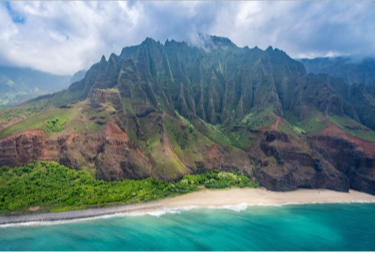

The Hawaiian Islands are the most remote landmasses on the planet, formed roughly 65 million years ago through volcanic activity. Over
millennia, plants and animals arrived on the island either via wind currents, imported with the arrival of people, or as stowaways on floating
detritus. Both have evolved and specialized so that birds and insects have minimal competition for food and plants have plant-specific pollinators. This has resulted in a unique habitat with many of the plants and animals being found nowhere else on Earth.
HEALTH OF EARLY HAWAIIANS
Although anthropologists and historians cannot agree on the exact timeframe of the arrival of humans to the Hawaiian Islands, Polynesians were the first to arrive, somewhere between 300-1266 CE, coming from what is now French Polynesia and Tonga. They brought with them – over the course of many voyages – their native medicinal plants (now referred to as canoe plants due to their mode of arrival), while at the same time incorporating native plants into the pharmacopeia. Based on observations by early explorers to the South Pacific, the Polynesians had very little in the way of medicinal plants, and those were primarily to treat accidental injuries, ie anti-inflammatories, salves to heal open sores, analgesia for menstrual issues and injuries, etc. There are no recorded notations of antimicrobials in the islands, as natives “…displayed an ability to stay healthy and not get infections.” (Palmer, 2004). For centuries the combination of native Hawaiian and imported plants sufficed to keep the Hawaiians healthy, obesity and its related issues notwithstanding, none of which were known to the population at that time. The Hawaiian population was remarkably healthy, increasing and the King and his Kahunas (medical healers) ensured society prospered.
THE ARRIVAL OF UNKNOWN DISEASES
In 1778 James Cook arrived on the islands and not long after that the missionaries from Europe and the Americas started to arrive. In addition to the large influx of missionaries came entrepreneurs, and within a few decades much of the land had been turned into sugar cane cultivation. The locals were not willing to work the land and so the importation of Chinese migrants began, followed not long afterwards by Japanese, Koreans, Puerto Rican, Portuguese and Filipinos. The missionaries and the workers all brought their own healing plants.
They also brought disease.
Living on the most remote islands in the world and descending from a culture with virtually no infectious disease in their history, the awaiians had no immunity to the pathogens! Populations started to decline. The locals had no knowledge of how to treat these diseases. Guesswork became the norm using remedies from various cultures. So it was with the leprosy outbreak in 1916 – and it was a local oil (Chaulmoogra) that helped to halt the epidemic and provide treatment for Hawaii’s lepers.
THE PRACTICE OF TRADITIONAL MEDICINE
It is known through journals that early Hawaiian medicine was delineated into specific body systems much like that which was practiced in Allopathic systems, ie neurological, reproductive, respiratory, circulatory and so on. The local system prioritized the health of the psyche – if one’s psyche was balanced then physical health could follow. The Kahuna had innate knowledge passed down through generations of anatomy and physiology, but it was the use of a haha (a hands-on clinical assessment) which provided diagnosis and direction.
Today’s herbal medicinal practices in Hawaii continue to have a strong hold in many of the communities, particularly native Hawaiian and Chinese. “Kahuna medicine” is often still used as a first line treatment for everything from simple cuts to skin disorders, and often used in conjunction with Allopathic therapies. Traditional remedies often dot the Health and Wellness sections of magazines and newspapers (particularly Mamaki; see below).
KAHUNA MEDICINES OF HAWAI’I
Some of the most well-known Hawaiian therapies still focus on anti- inflammatory properties and more simple healing remedies, much as it did back in the South Pacific.
Kava-Kava (Awa in Hawaiian; latin: Piper methysticum), shown above, was originally used as a ceremonial concoction, inducing a state of relaxed euphoria’ – thought to promote clarity. It was then used in the leper colonies to treat skin lesions. Today it is still used in the islands for many ailments – as a muscle relaxant, a sleep aid and a mild analgesic, but its primary use is as a nerve relaxant. Kava-Kava is marketed in the West as an antibacterial for urinary tract infections, to even out moods, and as a potential cancer therapy, but most often as a nervine relaxant for anxiety and stress reduction. Kava is still used today in Hawai’i and the South Pacific, but is banned in many Western nations due to a questionable research study linking it (weakly) to liver failure.
One of the endemic species still thriving on the islands today, Mamaki is an herb used to relieve cough and sore throat, and indeed, does have
antibacterial and antiviral properties against upper respiratory tract infections. There are some studies that show this plant could have a role in chemoprevention, too. Noni, a small tree that favours volcanic rock as a growing environment, can be very effective in treating severe ilments like high blood pressure, heart diseases, diabetes, and skin ailments. Still growing wild throughout the South Pacific, locals can pluck a fruit off a tree whenever they need it, ensuring optimal ingredients straight from the source. A 1990’s health fad in the West saw Noni juice for sale just about everywhere, but how much actual therapeutic content is in the juice is hard to say, and certainly not likely to be health-affecting. Perhaps Noni should be used only as recommended by a Kahuna!
Turmeric was introduced to Polynesia from India/Southeast Asia via other civilizations in Oceania. Originally used in Polynesia as a food additive and a dye, but Turmeric’s strong anti-inflammatory properties were soon discovered. This was one of the canoe plants brought to the islands. Traditional Hawaiian healers used Turmeric topically for skin rashes and sores and as a tea additive for curing coughs and sore throats. Its uses today are essentially unchanged. I’ll cover Turmeric in-depth in a later article.
In the last two decades alone our planet has ‘shrunk’ considerably as our knowledge of far lands has grown. There are more human migrations,
travelers, global markets, and information exchanges than ever before. Regional therapies are going global and people everywhere are benefitting greatly from that. While researchers are finding connections worldwide that many plant remedies have been used in similar fashions by various ancient (and not-so-ancient) civilizations, these studies are primarily focused on the plants of the large continents. The smaller islands are easily overlooked, yet due to their isolation they often have very unique flora not found elsewhere,having had the freedom to adapt to their environment often without the threat of predation. With the isolation of Hawai’i and the extreme specializations
found in its flora and fauna, this is an island chain that should not be overlooked as a microsystem for our remedy cupboard.
* NOTE: The English spelling of Hawaii is used without the use of the okina, (a consonant denoted in English by the apostrophe), ie Hawai’i. Both are considered correct by the government of Hawai’i at this time. Here, I use the traditional Hawaiian spelling.
REFERENCES
Brewster, C. (2018). How the Woman Who Found a Leprosy Treatment Was Almost Lost to History. National Geographic. Viewed September 13, 2019. https://www.nationalgeographic.com/news/2018/02/alice-ball-leprosy-hansens- disease-hawaii-womens-history-science/
Palmer, C. (2004). The Inclusion of Recently Introduced Plants in the Hawaiian Ethnopharmacopoeia. Economic Botany,58, S280-S293. Retrieved from http://www.jstor.org/stable/4256925 Wilmshurst, J. Hunt, T. Lipo, C. Anderson, A (2011). High-precision radiocarbon
dating shows recent and rapid initial human colonization of East Polynesia. Proceedings of the National Academy of Sciences, 108 (5) 1815-1820.
Photo Acknowledgements:
1. Na Pali Coast – Expert Vagabond
2. Kava – Gaia Herbs
3. Noni – IVC Journal
4. Mamaki – David Eickhoff, Hawaii Magazine
5. Turmeric – Herbal Reality


0 Comments