
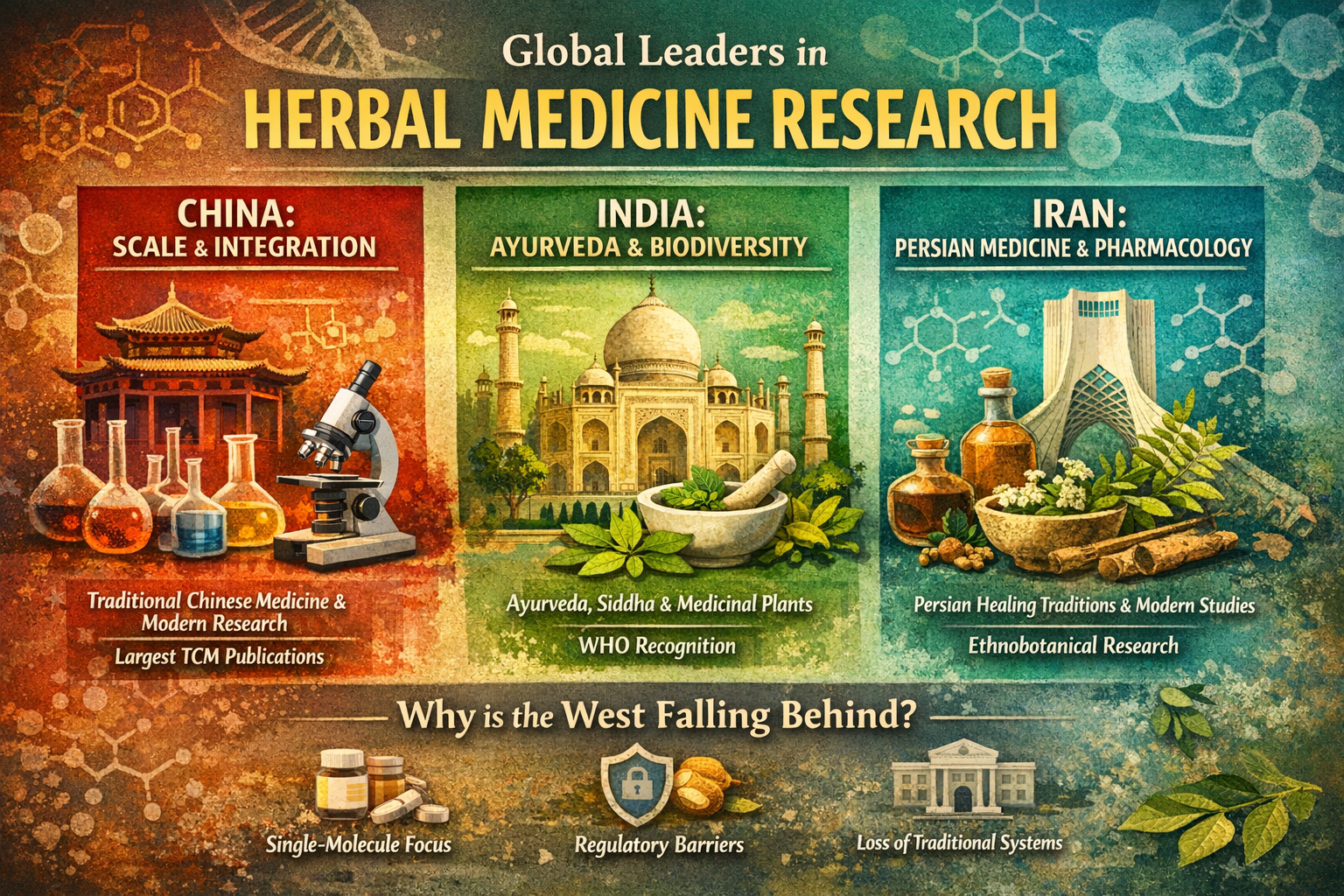

Herbal medicine is no longer confined to tradition — it is an active and expanding field of scientific research. While many nations contribute to botanical science, three countries consistently lead global herbal medicine research: China, India, and Iran. Each of these countries maintains an unbroken connection with ancient plant-based systems.
China: Scale, Funding, and Institutional Integration
China is widely recognized as the largest producer of peer-reviewed research in Traditional Chinese Medicine (TCM). Major universities, research hospitals, and state-funded institutions systematically study herbal pharmacology, clinical applications, and safety standardization. A bibliometric analysis published in Frontiers in Pharmacology confirms China’s dominant publication output in traditional medicine research fields:
https://www.frontiersin.org/articles/10.3389/fphar.2022.901710/full
China’s research strength comes from integration. Herbal medicine is not isolated from conventional healthcare; it is studied alongside biomedical science, allowing for laboratory testing, clinical trials, and pharmacological analysis of traditional formulas.
India: Living Traditions and Expanding Scientific Validation
India’s leadership stems from Ayurveda, Siddha, and Unani systems — traditions that remain widely practiced and formally taught. The country’s biodiversity also provides one of the richest medicinal plant resources in the world.
The World Health Organization (WHO) acknowledges India’s role in advancing traditional medicine research and standardization within its global strategy on traditional medicine:
https://www.who.int/publications/i/item/9789240045484
India’s Ministry of AYUSH actively funds research into medicinal plants, quality control, and clinical validation. Rather than separating tradition from science, India increasingly uses traditional frameworks as research hypotheses, which are then tested under modern protocols.
Iran: Translating Traditional Persian Medicine into Modern Study
Iran has become a significant contributor to herbal medicine research, particularly in pharmacology and ethnobotany. Traditional Persian Medicine provides a structured historical knowledge base that researchers use to guide laboratory and clinical studies.
A comprehensive review of Iranian medicinal plants published in Avicenna Journal of Phytomedicine highlights how traditional uses are being scientifically evaluated:
https://www.ncbi.nlm.nih.gov/pmc/articles/PMC7143749/
Iran’s strength lies in bridging documented traditional knowledge with phytochemical analysis and modern safety evaluation.
Why Are Western Nations Perceived as Behind?
Western countries conduct high-quality botanical research, yet they often lack an intact, living plant-based medical system integrated into mainstream healthcare. Regulatory systems in North America and Europe are structured around single-molecule pharmaceuticals. Herbal formulas that contain multiple active compounds working synergistically do not always fit neatly into this model.
A review published in Journal of Ethnopharmacology discusses regulatory and intellectual property challenges affecting traditional medicine integration in Western healthcare systems:
https://www.sciencedirect.com/science/article/abs/pii/S0378874118303157
However, Germany stands as an important Western exception. Through the work of Commission E, Germany formally evaluates and publishes scientific monographs on medicinal plants, and several botanicals — such as Crataegus (Hawthorn) — are included in the German pharmaceutical formulary for cardiovascular support. The European Scientific Cooperative on Phytotherapy (ESCOP) monographs document the clinical evidence supporting Hawthorn’s use in heart conditions:
https://escop.com/monographs/
Canada has also contributed to evidence-informed herbal research, including work examining traditional plant use and modern pharmacological validation. Health Canada maintains a Natural and Non-prescription Health Products Directorate that evaluates herbal products based on safety and efficacy evidence:
https://www.canada.ca/en/health-canada/services/drugs-health-products/natural-non-prescription.html
These examples demonstrate that herbal medicine is recognized within Western regulatory frameworks when supported by scientific evaluation.
In many Western contexts, plant medicine became marginalized during the rapid expansion of industrial pharmaceutical development in the 20th century. The result was not a loss of plants themselves, but a loss of institutional continuity.
Returning to Our Plant Roots — Responsibly
The question is not whether herbal medicine works, but how it can be applied safely, effectively, and individually. Evidence-informed herbal care requires more than reading studies — it requires proper assessment, dosage understanding, herb–drug interaction screening, and personalized planning.
At The Herbal Clinic and Academy, consultations bridge tradition and science. Each recommendation is guided by current research, clinical reasoning, and individualized assessment — not trends or assumptions.
If you are curious about herbal options for your health goals, a professional consultation ensures that your plan is safe, evidence-informed, and tailored to your unique needs.
Herbal medicine is evolving — and with the right guidance, you can explore it with confidence.

0 Comments